White hat SEO
White hat SEO follows search engine and AI platform guidelines: useful content, honest markup, open crawl access and links people choose to give.

Blog · October 13, 2026
A new preprint found Google results and OpenAI's API matched only 26.2% of the pages ChatGPT cited, but 48.7% of the sites. What that means for ChatGPT SEO tracking.
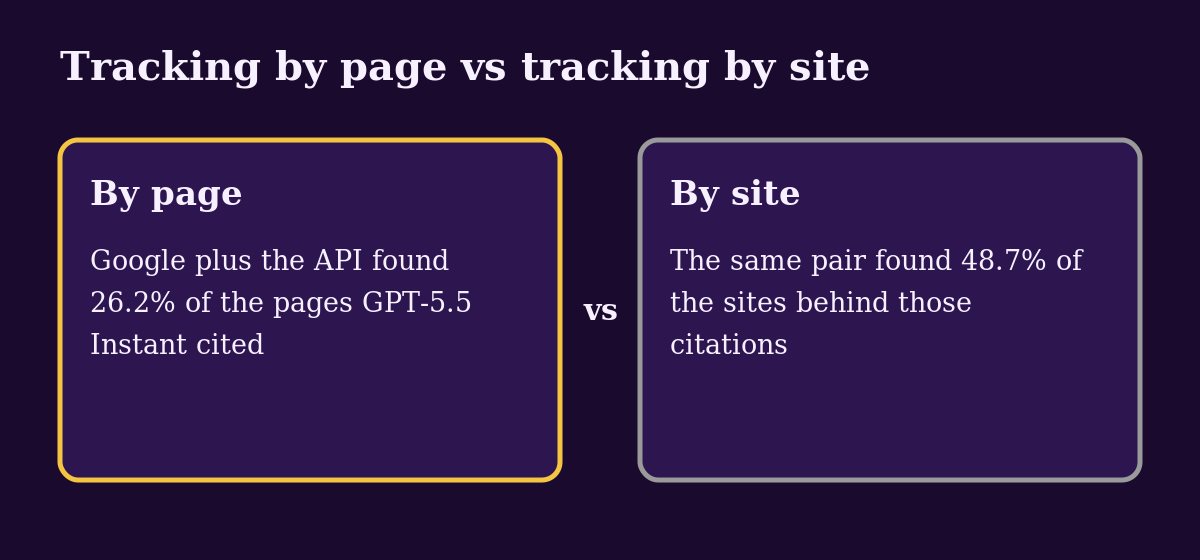
If you want to rank in ChatGPT, you need to know whether you're being cited at all, and a new preprint suggests the shortcuts most people use to check only see part of the picture. Search Engine Journal reported on October 18 that researchers at the National University of Singapore and Xi'an Jiaotong University compared ChatGPT's real citations against Google results and OpenAI's Responses API. Combined, those two stand-ins found only 26.2% of the pages GPT-5.5 Instant cited, but 48.7% of the sites behind them.
The team recorded what ChatGPT's web app did in their own signed-in sessions: the searches it ran, the pages those searches returned and the pages it chose as sources. They ran 80 real questions from the public Search Arena dataset, 40 in English and 40 in Chinese, 20 times each on GPT-5.3 Instant and GPT-5.5 Instant, mostly between March 29 and July 29, 2026. It's an arXiv preprint, so it hasn't been peer reviewed, and it didn't test any commercial tracking tool.
Three findings matter for ChatGPT SEO. ChatGPT never searched with the exact wording of the question on GPT-5.3 or GPT-5.5; it rewrote it into its own queries. Answers moved a lot between runs, with 44.5% of the distinct pages for a question showing up in only one of 20 GPT-5.5 runs. And for Chinese questions, roughly two-thirds of runs with visible searches searched only in English.
This lines up with what our sister agency CheapAITraffic found about why ChatGPT visits keep landing in Direct: clicks from AI answers are already hard to see, so citation tracking has to be honest about its own blind spots too.
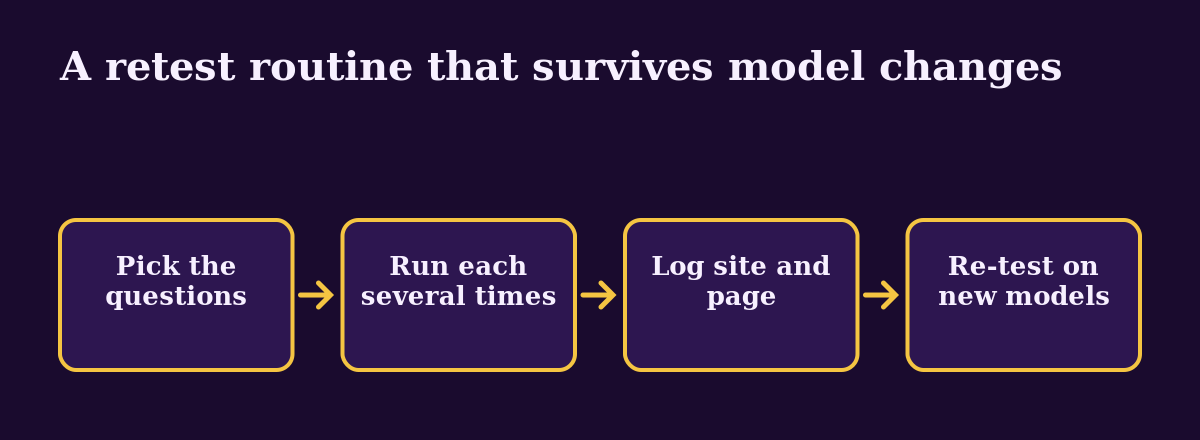
ChatGPTKing focuses on one job: AI answer optimization for ChatGPT and the other assistants. Prompt retests and upkeep after model changes are already a named step in how we work, so a finding like this changes our checklist, not our pitch. We rewrite the pages that should win specific questions, fix the crawler and rendering plumbing, and report what we can actually observe. We are not affiliated with OpenAI, we don't sell placements, and we won't promise a number-one spot. When a page needs a broader rewrite, BuyAISearch's note on ChatGPT leaning on primary sources is a useful companion, and visibility pushes run as AI discoverability campaigns on neetbros.
Want this done for you? Start with our free AI discoverability audit. Campaigns are delivered through neetbros discovery campaigns.
White hat SEO follows search engine and AI platform guidelines: useful content, honest markup, open crawl access and links people choose to give.
Black hat SEO tries to trick ranking systems with things like hidden text, link schemes, cloaking, fake reviews or bot traffic. It can work briefly, and it can get a site penalized or quietly ignored.
Never the black one. No spam, no hacks, nothing that risks a penalty. LLM search is still growing, and we stay ahead of the latest legit techniques. Stay tuned to the royal blog for free tips. Read the blog →